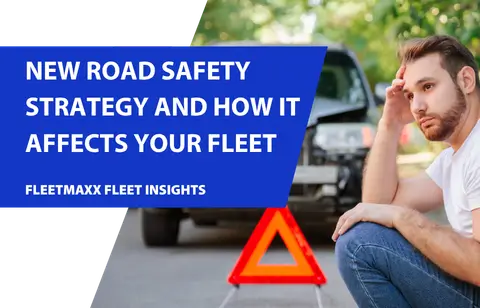
New road safety strategy: Why fleets cannot afford to sit this one out
Road Safety Strategy Guide by Steve Clarke, Marketing Manager at Fleetmaxx Solutions
If you run a fleet, manage drivers, or even just keep a close eye on operating costs, this is one of those moments where you want to lean in, not scroll past.
Because the Government’s new road safety strategy is not just another policy document gathering dust on a shelf. It is shaping up to be a genuine shift in how road risk is viewed, managed and enforced across the UK.
And for fleets, it could change the rules of the game.
Road safety strategy table of contents
- A turning point for road safety
- The scale of the challenge
- What is actually being proposed
- Drink and drug driving changes
- Why fleets are firmly in the spotlight
- A national standard for employers
- Collisions under the microscope
- The growing role of vehicle technology
- What this means for your business
A turning point for road safety strategy
The Government has launched its first road safety strategy in more than a decade, and it is not holding back.
Transport Secretary Heidi Alexander described it as a turning point, and when you look at the ambition, you can see why. For the first time, there is a clear target to reduce deaths and serious injuries on UK roads by 65% by 2035.
That is not a small policy update. That is a major shift in direction.
And importantly for those of us in the fleet world, driving for work is no longer being treated as just a transport issue. It is increasingly being recognised as a workplace safety responsibility, which means businesses need to pay very close attention.
The scale of the challenge
Let us put this into perspective.
On average, four people lose their lives on Britain’s roads every day, with more than 70 seriously injured. In 2024 alone, there were 1,602 fatalities.
More striking still, around one in three road traffic fatalities involves someone driving or riding for work.
That means road safety is not just a transport story. It is a business issue, a compliance issue and, increasingly, a leadership issue too.
What is actually being proposed in the road safety strategy
The strategy is wide-ranging and backed by several consultations covering everything from motoring offences to vehicle technology.
Key proposals include targets for reducing road deaths and serious injuries, a national standard for employers whose staff drive for work, lower drink-drive limits in England and Wales, tougher penalties for dangerous drivers, mandatory vehicle safety technologies, a new road safety investigation branch, minimum learning periods for learner drivers and mandatory eyesight testing for drivers over 70.
It is a broad and ambitious package, and it is clear the Government wants to tackle road risk from every angle.
Drink and drug driving changes
Some of the most immediate impacts for fleets may come from proposed changes to drink and drug driving enforcement.
The Government wants to lower the legal alcohol limit in England and Wales, bringing it more into line with Scotland’s stricter position. Northern Ireland is also moving in that direction, with plans for even lower limits for professional and novice drivers.
On the drug-driving side, quicker testing methods such as oral fluid, saliva or sweat are being considered, which could speed up enforcement and reduce pressure on forensic services.
There is also discussion around temporary licence suspension for those arrested on suspicion of drink or drug driving, meaning drivers could be taken off the road much earlier in the process.
For businesses that rely on drivers every day, that has very real operational implications.
Why fleets are firmly in the spotlight
This is where things become especially relevant for employers.
The strategy reinforces the view that road risk should be managed as part of workplace health and safety. In other words, if one of your drivers is involved in a serious incident, attention may not stop with the person behind the wheel. Investigators and enforcement bodies may also look closely at the systems, processes and management culture behind them.
That means businesses need to think carefully about how they monitor driver behaviour, how they support vehicle safety, how they evidence training and how clearly they can demonstrate that risk is being managed properly.
This is exactly why more operators are investing in tools like Fleetloc8 vehicle tracking and telematics, alongside specialist transport consultancy support, to gain better visibility and stronger control over day-to-day fleet risk.
It is also why digital compliance tools such as CheckedSafe are becoming increasingly valuable, helping businesses build clear, auditable records around daily checks, defect reporting and maintenance oversight.
A national standard for employers
One of the biggest developments in the strategy is the proposed national standard for employers who require staff to drive or ride for work.
This would cover everything from HGVs and vans to company cars, motorcycles, e-bikes and cycles.
Initially, the standard will be voluntary. But as many in the industry already know, voluntary schemes often become the benchmark businesses are judged against after something goes wrong.
So while it may not be mandatory from day one, it would be wise for fleets not to dismiss it. Best practice has a funny way of becoming expected practice.
Collisions under the microscope
Another major proposal is the creation of a new road safety investigation branch.
Rather than investigating every single collision in detail, this body would take a broader, more strategic approach, looking at patterns, common causes and system-wide failings.
The aim is not simply to assign blame. It is to learn from real-world incidents and use that evidence to shape safer roads, better enforcement, stronger vehicle standards and more effective prevention.
For fleets, that brings data into even sharper focus. Businesses already collect huge amounts of useful operational information, but the real value comes from how well that data is understood and acted on.
Whether it is tracking trends through Fleetloc8, tightening up compliance through CheckedSafe, or reviewing procedures through our consultancy services, the direction of travel is clear. Safer fleets will be the ones that use evidence, not instinct alone.
The growing role of vehicle technology in the new road safety strategy
Technology is also set to play a much bigger part in the future of road safety.
The Government is consulting on mandating 18 different vehicle safety technologies, including automatic emergency braking, lane keeping assistance, intelligent speed assistance and driver monitoring systems.
These features have the potential to prevent a significant number of collisions and casualties over time, and they would bring the UK more closely into line with European requirements.
But there is a catch. Technology only delivers results when drivers understand it, trust it and use it properly.
We have all seen cases where alerts are ignored, systems are switched off, or drivers become over-reliant on assistance features. That is why training, communication and consistent policy matter just as much as the technology itself.
What this means for your business
For me, the biggest takeaway is simple. This is not something fleets can afford to sit back and watch from the sidelines.
The businesses that will be in the strongest position are the ones already taking road risk seriously, already reviewing their systems and already using the right tools to improve visibility, accountability and compliance.
That might mean making better use of Fleetloc8 telematics, strengthening processes through our transport consultancy services, or building more robust inspection and defect reporting procedures with CheckedSafe.
Because when expectations rise, and they will, you do not want to be scrambling to catch up.
At Fleetmaxx Solutions, we believe good road safety practice is not just about ticking boxes. It is about protecting your drivers, your vehicles, your reputation and your bottom line.
And in a world where driving for work is under increasing scrutiny, that matters more than ever.