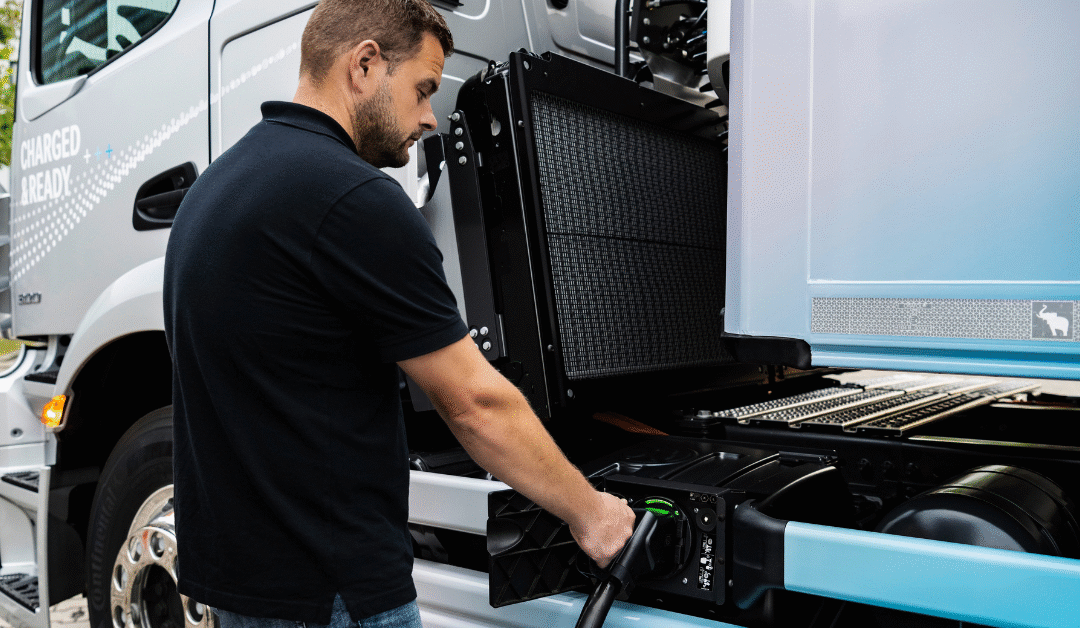
Why public charging investment matters now more than ever – Daimler Trucks
Daimler Truck eHGV revolutions by Kyle Davey – Sales Manager & EV Specialist, Fleetmaxx Solutions Ipswich
The shift to electric HGVs is accelerating, but for many operators, the decision to invest in battery-electric trucks still comes down to one question:
Can I charge them reliably, quickly, and cost-effectively while keeping my business moving?
Right now, the answer depends largely on infrastructure—and that’s why Daimler Truck UK’s recent call for increased public charging investment is such a crucial conversation for our industry.
£30m for depot charging – welcome progress, but not the whole answer, say Daimler Truck
The UK Government’s recent announcement of £30 million in funding for its Depot Charging Scheme (DCS) is part of a wider £63 million push to accelerate the EV transition. The funding will support the installation of more than 3,000 van chargepoints and over 200 dedicated HGV chargepoints.
It’s an important step that will help reduce operational costs, improve efficiency, and speed up the adoption of zero-emission vehicles.
But as James Venables, Daimler Truck UK’s Head of Future Sustainability, points out—there’s more to do.
“It’s clear that to boost the take-up of battery-electric vehicles further we need more places where they can be charged,” says Venables. “If we’re to invest in infrastructure, then the money needs to be well spent—creating more dedicated HGV public charging points on our road network. For those points to be truly effective they must offer high enough power ratings and be sited in the right places.”

What makes an effective HGV charging network?
Daimler’s position is clear: building confidence in eHGVs means creating a network that works for logistics operations in the real world. That means:
- High-powered charging – Megawatt Charging Systems (MCS) and 400kW+ CCS chargers to minimise downtime.
- Strategic placement – chargers located where HGVs already stop: busy freight corridors, delivery hubs, and motorway services.
- Integration with work patterns – the ability to charge during mandatory driver breaks instead of adding extra stops.
- Smart management tools – pre-booking, real-time availability, and integrated payment systems.
- Cost competitiveness – charging that doesn’t erode the savings of switching from diesel.
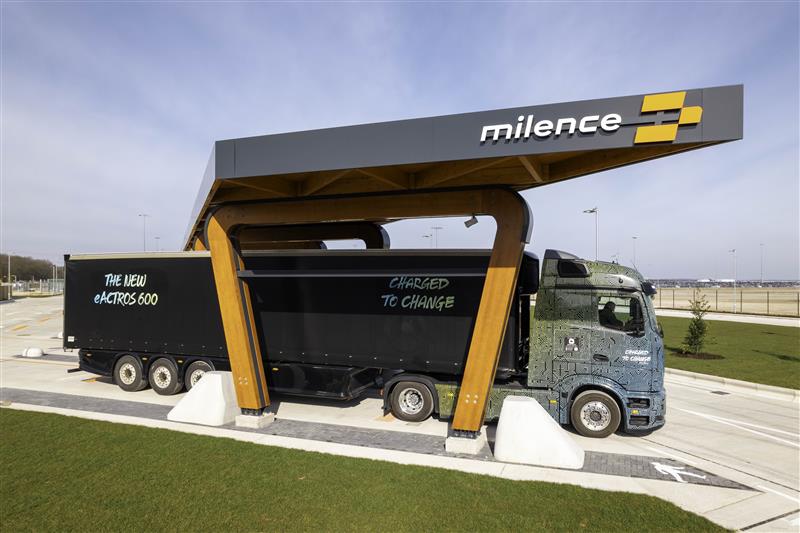
Venables highlights the importance of timing. For example, Daimler’s eActros 600 can travel at least 500 km (310 miles) on a single charge at a full 40t GCW. Using standard CCS charging (up to 400kW), a 20–80% charge takes under 60 minutes. With megawatt charging, that drops to around 30 minutes—the perfect fit for a statutory driver break, enabling a truck to cover 1,000 km (620 miles) in a single day without extra downtime.

Beyond the depot – why public charging is the missing piece
Many fleets are planning to install depot charging, but Venables emphasises that public infrastructure is the key enabler. Not every journey starts and ends at a depot—and not every fleet can rely solely on overnight charging.
He also stresses that charging must be cost-effective and intelligent. That means letting drivers reserve slots, view live charger status, and pay easily through integrated systems. Without these features, chargers risk becoming bottlenecks instead of enablers.
Industry collaboration is already underway
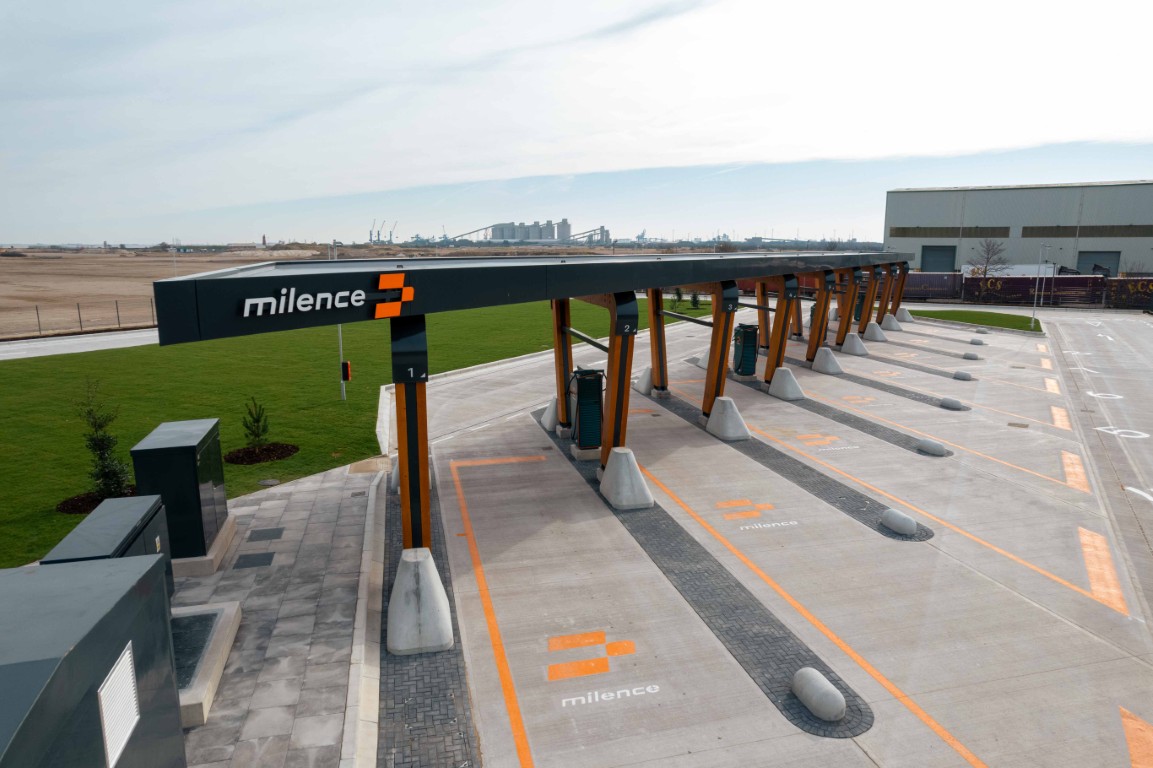
The private sector is stepping up. Daimler Truck is part of Milence, a joint venture with Volvo Group and the Traton Group, building a network of public HGV charging sites across Europe. The UK’s first Milence site in Immingham is already open, with more locations to follow.
But as Venables notes, private investment alone isn’t enough. To deliver the charging coverage and capacity that will make eHGVs mainstream, government support must match industry ambition.
“The more we can do to support early adopters of electric trucks, the more vehicles will be seen out and about on our roads—covering the distances, hauling the loads, and giving other operators confidence that electric trucks can work successfully in the real world,” he says.
Shell Markham Moor milestone – proof of progress

Here in the UK, one of the most exciting recent developments is Shell’s launch of their first public HGV charging point at Markham Moor Truck Stop in Nottinghamshire—right on the busy A1 corridor used by over 8,000 HGVs every day.
The new 400kW high-power charger is designed for heavy goods vehicles and ticks all the boxes for effective infrastructure:
- Book and Charge – reserve a bay to avoid queues.
- Shell Card integration – charge, refuel, and pay for AdBlue® on one account.
- 100% renewable electricity – cutting carbon from the grid connection.
- Full driver facilities – secure parking, showers, café, and a Little Waitrose.
This is exactly the type of location and service model Daimler is talking about—charging integrated into the driver’s natural routine, backed by the facilities and network coverage operators need.
Fleetmaxx – helping your fleet take the next step
At Fleetmaxx Solutions, we work with fleets of all sizes—from single-vehicle operators to national logistics companies—to make the EV transition practical, cost-effective, and future-proof.
As Shell’s Fuel Card Reseller of the Year 2024, we’re proud to offer a range of EV and hybrid-ready fuel cards that give you access to the growing Shell Recharge network, including flagship locations like Markham Moor:
- Shell Recharge Card – access Shell’s expanding EV charging network.
- Shell Hybrid Fuel Card – one card for diesel, petrol, and electric.
- Shell EV CRT Card – combine competitive diesel, EV charging, and AdBlue®.
With the right vehicle technology from innovators like Daimler, the right public charging investment from both government and industry, and the right payment and management tools from Fleetmaxx Solutions, the electric HGV future isn’t just possible—it’s ready to roll.
Ready to power your fleet’s future?
Contact Fleetmaxx Solutions today at 03302 320 220 to discover how our Shell Recharge and Hybrid fuel cards can support your diesel, petrol, and electric vehicle needs—helping you cut costs, streamline operations, and meet your sustainability goals.