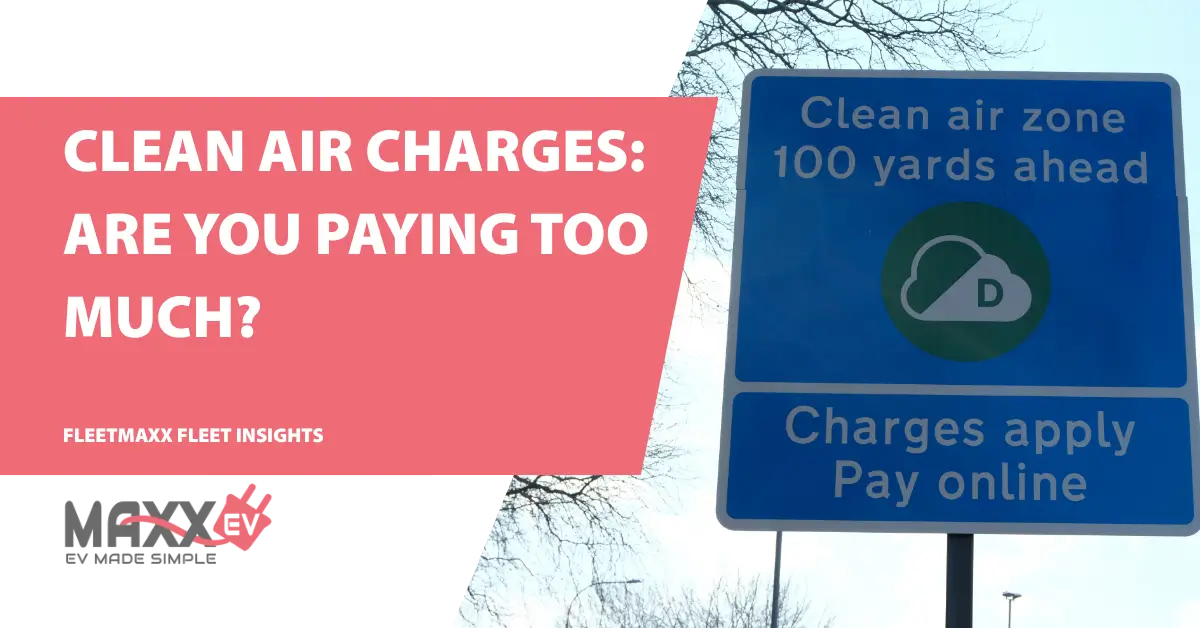
Clean air zone charges are costing van drivers £780 a year – Are you overpaying?
Clean air zone charges guide by Kyle Davey, EV Specialist, Fleetmaxx Solutions
For van drivers and small fleet operators, Clean Air Zones are no longer something that can be ignored or treated as an occasional inconvenience.
New research commissioned by Peugeot suggests that UK van drivers are spending an average of £780 a year on Clean Air Zone and Low Emission Zone charges and penalties. That works out at around £65 every month.
For businesses already dealing with high fuel prices, maintenance bills, insurance premiums and general operating costs, that is another significant expense eating into already tight margins.
I am Kyle Davey, Sales Manager at Fleetmaxx Solutions in Ipswich, and I work with businesses every day to help them understand and control the cost of running their vehicles. These figures should encourage every van operator to take a closer look at where their vehicles travel, whether they are compliant and what those journeys are really costing.
Clean Air Zone charges: London van drivers face the highest costs
According to the research reported by Fleet World, London van drivers face the greatest financial impact, spending an average of £99 per month, or almost £1,200 per year, on emission zone charges and penalties.
Van drivers operating within the Tyneside Clean Air Zone are not far behind, reportedly paying an average of £82 per month, equivalent to £984 per year.
This is not surprising when non-compliant vans can face a daily charge of £12.50 in both London and Tyneside.
A driver regularly entering one of these zones in a non-compliant vehicle could face a much higher annual bill:
Potential annual Clean Air Zone charges
Estimated cost for a non-compliant van entering each zone five days per week, before any penalty charges.
Estimates are based on entry five days per week for 52 weeks. Charges, boundaries and exemptions can change. Always check the relevant official authority before travelling.
Clean Air Zone charges can exceed maintenance and insurance
What really caught my attention was how Clean Air Zone costs now compare with other typical van expenses.
The Peugeot research estimates that commercial van drivers spend an average of:
Average annual costs for UK van drivers
Clean Air Zone and Low Emission Zone charges reportedly cost van drivers more than maintenance, parking fines or insurance.
Source: Peugeot research reported by Fleet World, August 2026.
Of course, every business is different. A local operator working entirely outside an emission zone may pay nothing, while a tradesperson travelling into London, Birmingham, Bristol or Tyneside every day could pay thousands of pounds a year.
That is why looking at your own routes and vehicle compliance is much more useful than relying on a national average.
Do you know whether every van in your fleet is compliant?
One of the most concerning findings is the apparent lack of awareness among drivers.
The research found that 19% of those surveyed were unsure whether their van met the required emissions standards. A further 15% knew that their vehicle did not comply.
That uncertainty can become expensive very quickly.
Different zones have different vehicle requirements, charges and payment arrangements. Scotland also operates differently from the charging zones in England. Non-compliant vehicles are prohibited from entering the Low Emission Zones in Aberdeen, Dundee, Edinburgh and Glasgow, with penalties issued for breaches.
Before sending a driver into an unfamiliar city, check the vehicle registration using the relevant official service. The GOV.UK Clean Air Zone service allows businesses to check vehicles for zones in Bath, Birmingham, Bradford, Bristol, Portsmouth, Sheffield and Tyneside. Separate services apply to London, Scotland and Oxford.
Businesses checking several vehicles can also create an account and upload a spreadsheet containing multiple registrations.
Do not assume that two similar vans will have the same status. The age, engine, fuel type and recorded emissions standard of each vehicle can affect whether a charge applies.
Councils have generated nearly £1.5 billion from Clean Air Zone charges
Freedom of Information data gathered for the research suggests that UK emission zones generated almost £1.5 billion in daily charges and penalty income up to 31 March 2026.
London accounts for the overwhelming majority, with the London Low Emission Zone and Ultra Low Emission Zone reportedly generating more than £1.2 billion between them over the periods covered.
Outside London, Birmingham Clean Air Zone reportedly generated almost £189 million between its launch in June 2021 and the end of March 2026.
Whatever your personal view of Clean Air Zones, the financial impact on commercial drivers is clear. For businesses, the important question is how to stop avoidable charges and penalties from quietly draining the fleet budget.
Five practical ways to control Clean Air Zone charges
1. Check every vehicle in your fleet
Create a complete list of vehicle registrations and check each one against the official services for the areas in which you operate.
Record the result centrally so drivers and transport managers can access it easily.
2. Review your regular routes
Look at how frequently each vehicle enters a charging zone. A single daily charge might not appear excessive, but repeated over weeks and months, it can become a major operating cost.
3. Allocate compliant vehicles carefully
If some vans are compliant and others are not, assign the compliant vehicles to work taking place inside emission zones wherever practical.
This simple scheduling decision could prevent hundreds or even thousands of pounds in unnecessary charges.
4. Make payment responsibilities clear
Decide whether the driver, transport manager or accounts team is responsible for checking and paying charges.
Leaving it unclear increases the risk of missed payments and penalty notices.
5. Compare the cost of keeping and replacing vehicles
Replacing a van is a major decision, and the numbers need to be considered carefully.
Look at the vehicle’s remaining finance, maintenance requirements, fuel use, Clean Air Zone exposure and expected working life. If a non-compliant van regularly enters charging zones, changing to a newer compliant model or an electric van may become more financially sensible.
Do not base the decision on the daily charge alone. Vehicle suitability, payload, range, charging arrangements, insurance, funding and total running costs all matter.
Could electric vans provide an alternative?
For some businesses, electric vans could offer a practical way to avoid emission zone charges while reducing tailpipe emissions.
They can work particularly well for predictable local routes, urban deliveries, service engineers and vehicles returning to the same depot or driver’s home each evening.
However, switching to electric vehicles needs proper planning. Businesses should consider:
- Daily mileage and journey patterns
- Payload and towing requirements
- Access to workplace or home charging
- EV charge cards for public charging
- Vehicle purchase or leasing costs
- Electricity tariffs
- Operational downtime
- Driver access and reimbursement arrangements
At Fleetmaxx Solutions, we can help businesses explore electric vehicle charging options, including public charge cards and Business Homecharge solutions. We can also help operators look at their wider fleet costs, including fuel cards, vehicle tracking and other tools designed to improve visibility and control.
Better information leads to better fleet decisions
The biggest lesson from this research is not simply that Clean Air Zones are expensive. It is that uncertainty is expensive.
If you do not know whether your vans are compliant, where they are travelling or how often they enter charging zones, it is very difficult to control the cost.
Start by checking every vehicle, reviewing your routes and calculating your actual annual exposure. Once you have those figures, you can make an informed decision about route planning, vehicle allocation, replacement schedules or moving suitable parts of your fleet to electric.
If you would like a friendly conversation about reducing your fleet running costs or exploring electric vehicle charging options, please contact me and the Fleetmaxx Solutions team. We will be happy to look at what could work for your business.

Disclaimer: The costs and research findings quoted in this article are based on Peugeot research reported by Fleet World in August 2026. Charges, boundaries, exemptions, eligibility rules and enforcement arrangements can change. Always check your vehicle and planned journey using the relevant official authority before travelling. Fleetmaxx Solutions does not operate or administer Clean Air Zones and cannot accept responsibility for charges or penalties incurred.