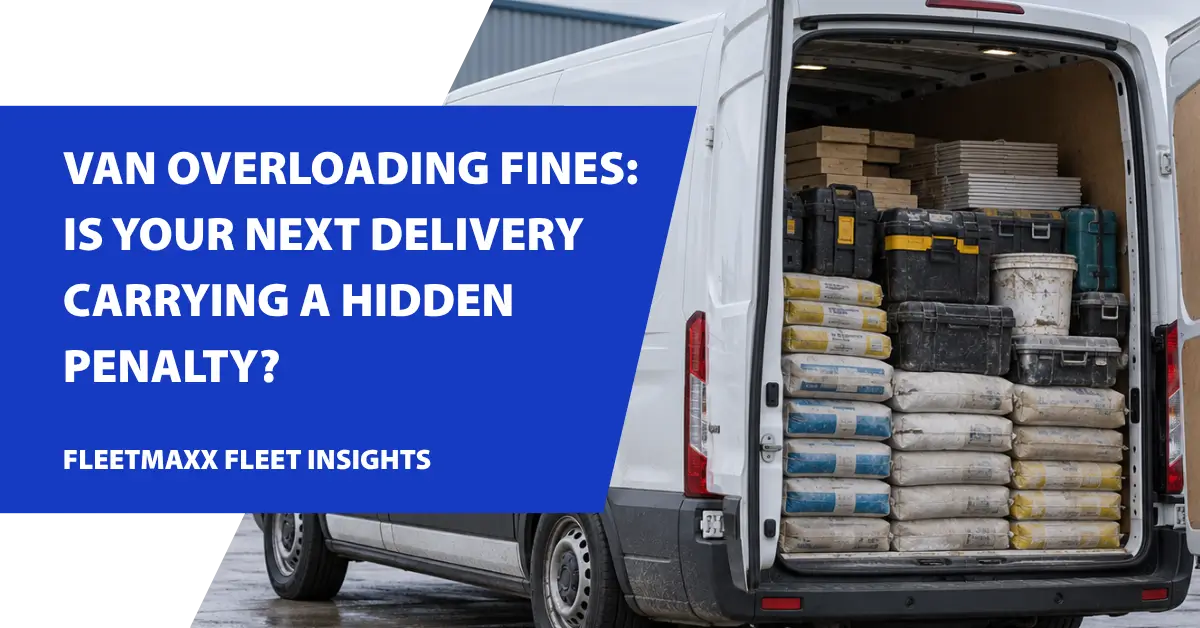
How much could you be fined for overloading a van?
Van overloading fines guide by Rachel Pearson, Advanced FORS Practitioner at Fleetmaxx Solutions in Whitstable
Axle limits matter too. A van can be within its overall weight limit and still exceed the permitted weight on an individual axle. Drivers and operators therefore need to check both the total vehicle weight and how the load is distributed.
This guide explains the weight rules, potential penalties and what can happen if a van is found to be overloaded.
Key takeaways
- The vehicle’s loaded weight includes the vehicle itself, fuel, driver, passengers, tools, equipment and goods.
- Both the maximum gross weight and individual axle limits must be respected.
- DVSA enforcement tolerance does not give legal permission to exceed weight limits.
- A fixed penalty does not give permission to continue driving an overloaded vehicle.
- Serious cases can lead to prosecution, and relevant overloading offences carry an unlimited maximum court fine in England and Wales.
Understanding commercial van weight limits
A van’s maximum authorised mass, also known as gross vehicle weight, is its maximum permitted weight when loaded. The total includes the vehicle, fuel, driver, passengers and everything being carried.
Cargo is only part of the calculation. Tools, shelving, equipment and other fitted accessories can reduce the capacity available for goods.
How to assess available carrying capacity
Available carrying capacity depends on the vehicle’s maximum authorised mass and its actual weight before additional passengers or goods are loaded.
Check what the manufacturer’s quoted kerb weight or mass in running order already includes, particularly fuel and any driver allowance. Definitions can differ, so adding these weights again could result in double counting.
For example, three additional passengers weighing 76 kg each add 228 kg to the vehicle’s actual weight before any extra goods are loaded.
A weighbridge can help establish the vehicle’s actual operating weight, including fitted equipment. Subtracting this from its maximum authorised mass shows the remaining gross weight capacity, but individual axle limits must also be checked.
Check gross weight and axle limits
The vehicle’s plate normally shows its maximum gross weight and individual axle limits. It may be located under the bonnet or inside a door frame. Consult the manufacturer’s information if you are unsure where to find it or how to interpret it.
A van can be within its overall gross weight limit but exceed the permitted weight on one axle. This can happen when heavy items are concentrated towards the front or rear.
Do not assume that spare capacity on one axle compensates for excess weight on another. Each applicable limit must be met.
Graduated van overloading fines
The fixed penalty depends on the percentage by which the relevant weight limit is exceeded. An axle overload is assessed against that axle’s permitted weight, while a gross overload is assessed against the vehicle’s maximum permitted gross weight.
Overloading a van: What could it cost?
Check the weight limit, understand the penalty bands and know what must happen before the journey continues.
1. Check gross and axle weight limits
Compare the measured weight with the relevant permitted limit. Check the vehicle’s plate and manufacturer’s information.
Gross weight limit
The maximum permitted loaded weight of the vehicle, including fuel, driver, passengers, tools, equipment and goods.
Individual axle limits
Each axle has its own permitted limit. A van can be within its overall weight limit and still have an overloaded front or rear axle.
2. Calculate the percentage overload
Calculate the excess against the particular limit being checked, rather than against the vehicle’s payload capacity.
Example: a van with a gross weight limit of 3,500 kg weighs 3,920 kg. The excess is 420 kg, giving a 12% gross overload.
3. Understand the fixed-penalty bands
| Excess over the relevant limit | Fixed penalty |
|---|---|
| Less than 10% | £100 |
| 10% to below 15% | £200 |
| 15% and above | £300 |
These are fixed-penalty amounts, not maximum court fines. Enforcement tolerance, road safety risks and prosecution policy affect how a case is dealt with.
The 5% tolerance is not extra capacity
DVSA guidance normally allows a 5% leeway before issuing an excess-weight fixed penalty or prohibition, unless the relevant limit has been exceeded by 1 tonne or more. This is enforcement tolerance, not permission to exceed the legal weight limit.
4. Serious cases may go to court
DVSA guidance normally treats an overload of 30% or more, or an excess of 5 tonnes or more, as too serious for a fixed penalty.
These thresholds do not guarantee a fixed penalty below them. Serious instability, loss of control or other safety concerns can lead to prosecution for additional offences.
Serious van overloading offences can result in prosecution rather than a fixed penalty. The maximum court fine depends on the vehicle category and applicable legislation. For goods vehicles over 3.5 tonnes, the maximum fine in England and Wales is unlimited. Courts consider the seriousness of the offence and the offender's financial circumstances when determining the penalty.
5. Deal with the load before continuing
DVSA can prohibit the vehicle from continuing. Paying a penalty does not give permission to drive on while overloaded or in breach of a prohibition.
Gross overload
Remove enough weight to bring the vehicle within its gross limit. Moving goods around inside the van does not reduce its total weight.
Axle overload
Redistribution or removal may resolve the excess. Check every applicable limit after changing the load.
Follow the examiner’s instructions, retain weighing records and notices, and continue only when the vehicle complies and any prohibition permits it.
Before the next journey
- Check the plated gross and individual axle limits.
- Allow for people, fuel, tools, fitted equipment and goods.
- Check what the manufacturer’s stated kerb weight or mass in running order already includes, so fuel or a driver allowance is not counted twice.
- Distribute and secure the load appropriately.
- Use suitable weighing facilities when necessary to confirm gross and axle weights.
Prohibitions and continuing your journey
Paying a penalty does not remove the need to comply with the weight limits or the conditions of a prohibition.
What should the driver do?
- Follow the examiner’s instructions.
- Keep the weighing information and any notices issued.
- Arrange to remove or redistribute the load safely, as appropriate.
- Check that both gross and axle weight limits are met.
- Resume the journey only when the vehicle complies and the prohibition permits it.
Redistributing a load may resolve an axle overload, but it will not reduce the vehicle’s total weight. A gross overload requires weight to be removed.
Court action for serious overloading
Serious overloading can result in prosecution rather than a roadside fixed penalty. Keep all notices, weighing records and relevant loading information, and follow the response instructions in the court paperwork.
In England and Wales, the relevant overloading offence is dealt with in the magistrates’ court and carries an unlimited maximum fine. The actual sentence depends on the offence, its seriousness and the offender’s financial circumstances.
How court sentencing differs from fixed penalties
Court sentencing guidelines are separate from DVSA’s roadside fixed-penalty bands.
The England and Wales guideline for lighter vehicles gives starting points for overloads up to and including 10%. It states that each additional percentage point of overload increases the penalty by 10%, with a penalty per overloaded axle. There is a separate guideline for goods vehicles over 3.5 tonnes.
These are sentencing guidelines, not a simple calculator for predicting the final fine.
The court and sentencing information in this section applies to England and Wales. Court procedures and penalties can differ elsewhere in the UK.
Overloading and dangerous driving
A serious overloading incident may involve additional offences if the vehicle’s condition or use creates danger. DVSA guidance identifies serious instability or loss of control as examples that can lead to prosecution for offences beyond excess weight alone.
A dangerous-driving allegation is separate from an ordinary overloading offence and carries different consequences. It does not automatically follow every case of overloading.
Driver and operator responsibility
Responsibility can extend beyond the person driving. The Road Traffic Act 1988 makes it an offence to use, cause or permit the use of a goods vehicle that breaches an applicable weight requirement.
Operators should have practical loading procedures, clear vehicle weight information and a way for drivers to raise concerns before setting off.
Refusing to comply with a lawful requirement to have a vehicle weighed can also be an offence.
Are there any statutory defences?
Section 41B of the Road Traffic Act 1988 provides specific defences for certain weight offences. These include qualifying journeys to the nearest available weighbridge after loading, or from a weighbridge to the nearest place where it is reasonably practicable to reduce the weight without obstructing a road.
A separate defence may apply where the excess is no more than 5%, the limit was not exceeded when loading was originally completed, and nobody has subsequently added to the load.
These defences depend on the exact circumstances and statutory conditions. They should not be treated as general permission to drive an overloaded vehicle.
Insurance and incident records
Overloading may affect an insurance claim, depending on the policy terms and circumstances. The weight and distribution of a load may also be relevant when responsibility for a collision is assessed.
Accurate loading and weighing records can help explain what was carried and how the vehicle’s weight was checked.
Responding to a fixed penalty
For DVSA fixed penalty notices issued in England and Wales, its published guidance lists the following options:
- Pay the fixed penalty within 28 days.
- Complain to DVSA within 10 days.
- Write to DVSA within 28 days to request a court hearing.
Read the instructions on the notice carefully and retain copies of correspondence. Different procedures can apply in Scotland, where conditional offers are used.
Fleetmaxx Solutions: Fleet compliance support
Managing vehicle weights is part of a wider approach to fleet safety and compliance. Clear responsibilities, practical loading checks and consistent records can help your team identify problems before a vehicle leaves the depot.
Fleetmaxx Solutions offers transport consultancy services to support businesses with their fleet compliance requirements.
If you would like to discuss support for your operation, contact Fleetmaxx Solutions.

Van overloading fines – Frequently asked questions
Why is overloading a problem?
Overloading can affect steering, braking and vehicle stability. It can also increase tyre wear and place additional strain on vehicle components. Poorly distributed or unsecured loads create further risks.
Can I be fined if I did not realise my van was overloaded?
Yes. Not knowing that the vehicle was overloaded does not, by itself, prevent enforcement. Responsibility can apply to the driver and anyone who causes or permits the vehicle’s use. Specific statutory defences may apply in limited circumstances.
Do you get points for overloading a van?
The overloading offence covered by the relevant England and Wales sentencing guideline is non-endorsable and does not attract penalty points. Separate offences arising from the same incident, such as dangerous driving, can have different consequences.
How can you avoid overloading a van?
Check the vehicle’s plated gross and axle limits. Establish its actual operating weight, including people, fuel, fitted equipment, tools and goods. Check how the load is distributed and secure it against movement. Use suitable weighing facilities where necessary to confirm gross and individual axle weights.
What happens if you overload a van?
The vehicle may be stopped and weighed. Enforcement can include a fixed penalty, a prohibition preventing further travel or prosecution. The load may need to be reduced or redistributed before the vehicle can continue, subject to the examiner’s instructions and any prohibition.
What are the costs?
Overloading fixed penalties range from £100 to £300, depending on the percentage by which the relevant weight limit is exceeded and DVSA enforcement policy. Serious cases may be prosecuted. In England and Wales, the relevant overloading offence carries an unlimited maximum court fine, and sentencing guidance provides for a penalty per overloaded axle.
Official sources and further reading on van overloading fines
- DVSA roadside checks: Fines and financial deposits
- GOV.UK: Vehicle weights explained
- Road Traffic Act 1988: Section 41B
- Sentencing Council: Overloading and exceeding axle weight
- DVSA enforcement sanctions policy
This article provides general information. Enforcement decisions depend on the circumstances, and court procedures and penalties vary by jurisdiction. Follow the instructions on any official notice and seek advice about a specific allegation where needed.