What is AdBlue®? A Complete Guide for Fleet Managers
What is AdBlue guide, Steve Clarke, Marketing Manager, Fleetmaxx Solutions
This guide is your complete solution. We cut through the confusion to explain exactly what AdBlue® is, why your diesel vehicles need it to meet UK emissions standards, and how it protects your fleet. Most importantly, we’ll share the proven strategies for purchasing AdBlue® smartly, helping you to slash your running costs, prevent expensive errors, and turn a necessary expense into a manageable part of your budget. It’s time to take control of your AdBlue® strategy and keep your vehicles on the road, for less.
What is AdBlue and Why is it Essential for Your Modern Diesel Fleet?
For any manager of a modern diesel fleet, understanding AdBlue is no longer optional—it’s a critical component of maintaining operational efficiency, managing costs, and ensuring legal compliance. In simple terms, AdBlue is the most widely recognised brand name for a non-toxic, colourless liquid used in modern diesel engines. Its primary function is to significantly reduce harmful emissions, specifically Nitrogen Oxides (NOx), produced during combustion.
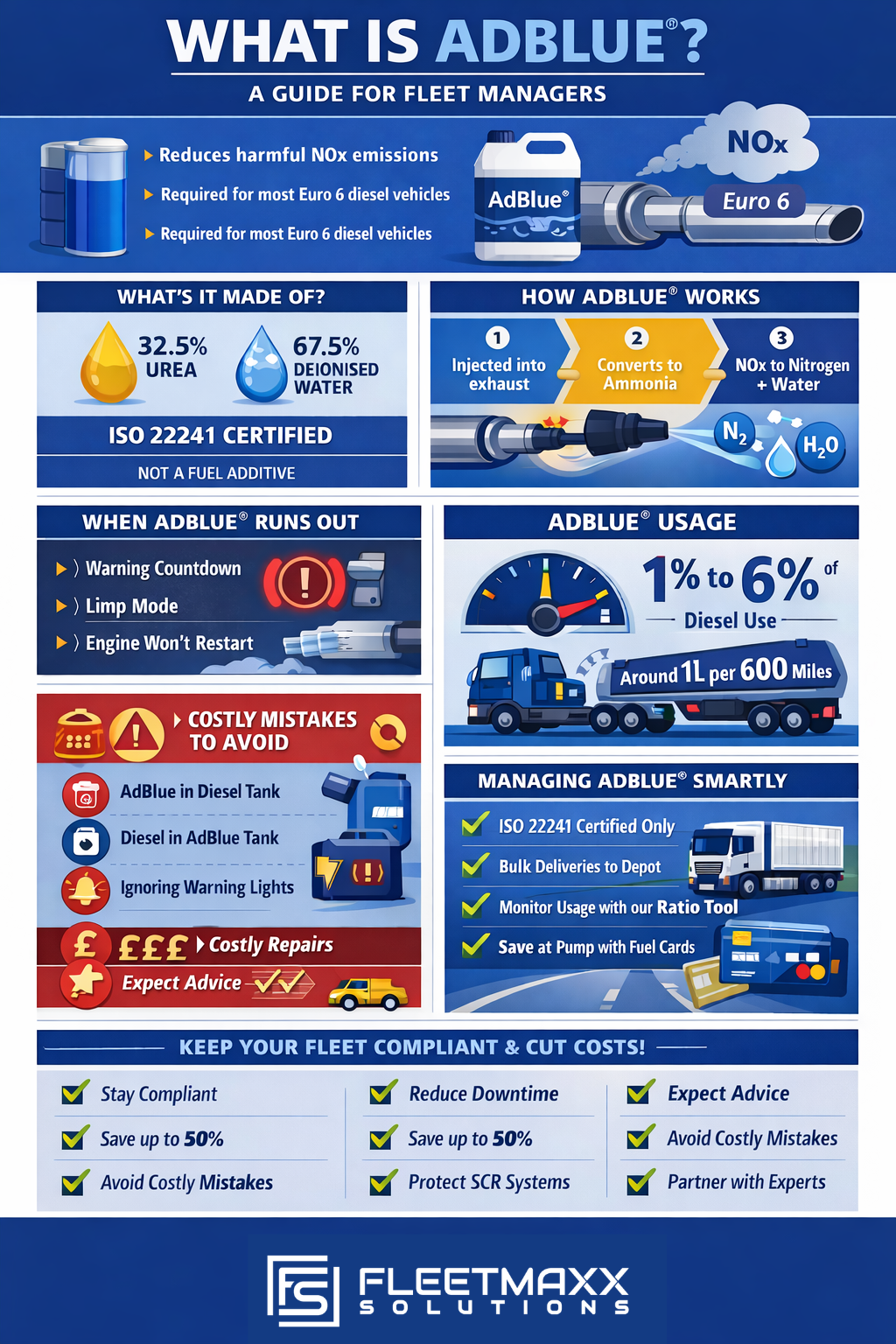
Crucially, it is not a fuel additive. It is stored in a dedicated tank, completely separate from your diesel, and is injected into the exhaust system. This process, known as Selective Catalytic Reduction (SCR), converts NOx into harmless nitrogen and water. In the UK, the use of this system is a legal requirement for most diesel vehicles to meet the stringent Euro 6 emissions standards. Failing to manage your fleet’s AdBlue levels can lead to severe consequences, including:
- Vehicle Downtime: Most vehicles will enter a reduced-power ‘limp mode’ or refuse to start if the tank runs empty.
- Financial Penalties: Operating a vehicle that does not meet emissions standards can result in significant fines.
- Reputational Damage: Non-compliance can harm your company’s image as a responsible operator.
What is AdBlue Made Of?
The composition of AdBlue is precise and essential for its function. It is a high-purity solution made of 32.5% urea and 67.5% deionised water. This specific concentration is critical for the SCR system to operate at peak efficiency. Contrary to some myths, it is a synthetic, carefully manufactured product and is not derived from animal urine. Using a fluid that doesn’t meet this exact standard can block or damage the sensitive and costly SCR system, leading to expensive repairs.
Which Vehicles Use AdBlue?
The need for this fluid is directly linked to Euro 6 emissions legislation. As a result, most diesel vehicles registered in the UK from September 2015 onwards are equipped with an SCR system that requires it. This applies across the commercial spectrum, from light commercial vans and HGVs to buses and coaches. While it is now common, not every diesel vehicle uses it; the requirement depends entirely on the specific emissions reduction technology the manufacturer has chosen to install.
How AdBlue Works: A Simple Guide to SCR Technology
To understand the role of AdBlue, you first need to understand the technology it enables: Selective Catalytic Reduction (SCR). This isn’t a complex fuel additive system; it’s a sophisticated after-treatment process that cleans up exhaust gases after they leave the engine but before they exit the vehicle. Integrated directly into your vehicle’s exhaust system, the SCR system features a dedicated tank for AdBlue, an injector, and a special catalytic converter.
The entire process is managed automatically by the vehicle’s engine control unit (ECU). While the engine is running, the ECU calculates the precise amount of fluid needed and injects it as a fine mist into the hot exhaust stream. This hands-off operation ensures optimal emissions control without requiring any action from the driver, aside from keeping the tank topped up.
The Chemical Reaction Explained
The science behind SCR technology is a straightforward and highly effective three-step chemical process designed to neutralise harmful pollutants:
- Step 1: Conversion to Ammonia. As the AdBlue solution is injected into the hot exhaust gases, the high temperature rapidly converts the urea within it into ammonia (NH₃).
- Step 2: Reaction in the Catalyst. This ammonia, along with the exhaust gases, passes into the SCR catalyst. Inside, the ammonia acts as a reducing agent, specifically targeting harmful Nitrogen Oxides (NOx).
- Step 3: Neutralisation. The chemical reaction converts the toxic NOx into two harmless substances: inert nitrogen (N₂), which makes up 78% of the air we breathe, and simple water vapour (H₂O).
Why ISO 22241 Specification is Non-Negotiable
For a fleet manager, the single most important detail about AdBlue is its quality standard: ISO 22241. This international standard dictates the precise purity and concentration of the urea solution. Using a non-compliant or uncertified fluid, even if it’s marketed as a cheaper alternative, introduces huge financial and operational risks.
Impurities found in low-quality solutions can irreversibly damage or “poison” the sensitive components of the SCR system, leading to sensor failures and catalyst blockages. This damage is not typically covered by vehicle warranties, leaving you with repair bills that can easily run into thousands of pounds (£) and significant vehicle downtime. To safeguard your assets and ensure fleet efficiency, using a certified product is the only viable solution. Fleetmaxx only manufactures and supplies VDA licensed AdBlue® to protect your fleet.
Managing AdBlue in Your Fleet: Consumption, Warnings, and Refilling
Proactive management of your fleet’s AdBlue is essential for maximising vehicle uptime and controlling operational costs. Understanding how much your vehicles consume, what the dashboard warnings mean, and the correct refilling procedure will prevent easily avoidable, and potentially expensive, roadside issues. Keeping your vehicles moving efficiently is our priority, and that includes managing consumables like adblue.
Understanding AdBlue Consumption Rates
AdBlue consumption is directly linked to fuel usage, typically ranging from 1% to 6% of your diesel consumption. The exact rate depends heavily on several factors:
- Vehicle Load: Heavier loads increase engine strain and, consequently, consumption.
- Driving Style: Aggressive driving with rapid acceleration uses more than smooth, consistent driving.
- Journey Type: Stop-start city driving consumes more than steady motorway cruising.
As a general estimate, one litre of AdBlue will last for approximately 600 miles, but this can vary significantly. For precise control, modern telematics systems can monitor levels in real-time, allowing you to predict refilling needs and reduce the risk of unexpected downtime.

Dashboard Warnings: What They Mean
It is crucial that your drivers are trained to recognise and act on AdBlue warnings immediately. Ignoring them will result in a vehicle that cannot be started. The system typically follows a three-stage warning process:
- First Warning: An initial alert, often amber, will appear on the dashboard with a message like ‘Refill AdBlue‘. It usually includes a mileage countdown, such as 1500 miles, giving you ample time to act.
- Amber Warning: As the level becomes critical, the warnings become more insistent. Some vehicles may enter a reduced power or ‘limp mode’ to encourage an immediate refill.
- Red / Final Warning: This is the final alert. It means the tank is empty or critically low. The vehicle will continue to run until the engine is switched off, but it will then enter a non-start condition and will not restart until the AdBlue tank is refilled.
How to Refill AdBlue Correctly
Refilling is straightforward but must be done carefully to avoid costly damage to the SCR system. The filler cap is almost always blue and located next to the main diesel filler cap. Always use dedicated, clean equipment to pour the fluid, as contamination with diesel, oil, or even tap water can cause thousands of pounds in repairs. Crucially, the system requires a minimum refill quantity—often 5 to 10 litres—to register the top-up and reset the warning lights.
Common AdBlue Mistakes and How to Avoid Costly Downtime
While AdBlue® is essential for modern diesel fleets, simple handling errors can lead to some of the most expensive and disruptive repairs. Understanding these common mistakes is the first step to implementing procedures that protect your vehicles, your budget, and your delivery schedules. A small investment in training can save thousands in vehicle downtime and repair bills.
Mistake 1: Putting AdBlue in the Diesel Tank
This is a frequent and costly error. If this happens, do not start the engine under any circumstances. AdBlue is water-based and highly corrosive to certain metals, seals, and pipework found in a diesel fuel system. Starting the engine will circulate the corrosive fluid, causing catastrophic damage to the fuel pump and injectors. The only solution is to have the fuel tank professionally drained and the entire system flushed before refilling with diesel.
Mistake 2: Putting Diesel in the AdBlue Tank
Arguably the more damaging mistake, contaminating the AdBlue tank with diesel is a fast track to a huge repair bill. Again, do not start the engine. Diesel is an oil and will coat the entire Selective Catalytic Reduction (SCR) system. This contamination destroys the sensitive SCR components, often requiring a complete system replacement that can cost upwards of £5,000 for a single HGV. The vehicle will be off the road for an extended period, compounding the financial impact.
Mistake 3: Ignoring the Warning Light
The low AdBlue warning light provides ample notice, yet ignoring it is a common cause of preventable downtime. Once the tank is empty, the vehicle’s engine management system will first reduce power (enter ‘limp mode’) and will eventually refuse to restart. The cost of a stranded vehicle is significant: recovery fees, driver downtime, and the severe commercial impact of a missed delivery. A clear company policy on immediate refilling is the simple, cost-effective solution.
To prevent these issues, integrate the following points into your driver training programme:
- Check the Cap: Always double-check you are using the correct, smaller, blue-capped filler point for AdBlue.
- No Substitutes: Never put anything other than certified AdBlue into the tank. Do not top up with water.
- Misfuelling Protocol: If a misfuelling occurs, do not turn on the ignition or start the engine. Report it to management immediately.
- Act on Warnings: Refill the AdBlue tank as soon as the warning light appears. Do not delay.
- Use Quality Product: Always use a fluid that meets the ISO 22241 standard to avoid damaging the SCR catalyst.
The Smart Way to Buy AdBlue: Cutting Costs with Bulk Supply
For any fleet manager, controlling operational costs is a top priority. While AdBlue is an essential fluid for modern diesel vehicles, how you purchase it can dramatically impact your bottom line. Relying on last-minute forecourt top-ups is a significant drain on your budget. The smart solution is to switch to a bulk supply strategy or a fuel card that offers dosicunts on AdBlue, a simple change that can unlock substantial savings and improve your fleet’s efficiency.
By moving away from expensive retail suppliers, businesses can often cut their expenditure by up to 50%, turning a necessary cost into a managed, predictable expense.
Comparing Your Purchasing Options
Choosing the right supply method depends on your fleet’s size and consumption rate. At Fleetmaxx Solutions, we provide a range of options to suit every operational need, ensuring you only pay for what you require.
- Retail Pumps & 10L Containers: While convenient for an emergency top-up, this is by far the most expensive way to purchase AdBlue. The price per litre at a service station is significantly higher, quickly inflating your running costs.
- 205-litre Drums: An excellent solution for small to medium-sized fleets with moderate usage. Drums are easy to handle and store on-site, offering a great balance between convenience and a significant cost reduction over retail prices.
- 1000-litre IBCs (Intermediate Bulk Containers): This is the most cost-effective option for larger fleets with consistent, high-volume demand. Purchasing an IBC delivers the lowest possible price per litre, maximising your savings and reducing the frequency of orders.
See how much your fleet could save. Get your instant AdBlue® quote today.
Best Practices for AdBlue Storage
To protect your investment and ensure your vehicles’ SCR systems remain fault-free, proper storage is crucial. Contaminated or degraded fluid can lead to costly repairs and vehicle downtime. Follow these simple guidelines:
- Shelf Life: When stored correctly, AdBlue typically has a shelf life of 12 months.
- Temperature: Keep it stored in a cool, dry place between -5°C and 25°C. Most importantly, it must be kept out of direct sunlight, which can cause the urea solution to degrade.
- Contamination Prevention: Never mix anything with your AdBlue. Always use dedicated and sealed containers, pumps, and funnels to prevent impurities from compromising its quality.
Ultimately, the key to unlocking these savings is partnering with a reliable, VDA-licensed supplier. As your trusted partner, Fleetmaxx Solutions guarantees a quality-assured product and the expertise to help you manage your supply effectively, keeping your vehicles on the road for less.
Drive down costs with a smarter AdBlue solution
Cut out the middleman and take control of your AdBlue spend. Fleetmaxx Solutions manufactures Fleetblue, our own licensed AdBlue® (Diesel Exhaust Fluid), right here in the UK to ISO 22241 standards, allowing us to deliver consistently high quality at the lowest possible price.
For maximum flexibility, AdBlue can be purchased in bulk directly, including our Smart Tank automatic top-up service from Fleetmaxx Solutions or at the pump using our fuel cards, including the Shell CRT fuel card, where discounted AdBlue is available at selected filling stations. This gives your drivers the convenience of refuelling on the road, while you keep costs firmly under control.
Fleetblue is available in a full range of supply options to suit every fleet operation:
-
1,000L Intermediate Bulk Containers (IBCs)
-
205L barrels
-
20L, 10L, and 5L containers
-
Bulk deliveries direct to your depot
-
Smart Tank with automatic top-up service
On average, customers buying AdBlue from Fleetmaxx Solutions save up to 50% compared to forecourt prices, delivering up to £500 in savings per 1,000 litres versus standard pump rates.
As explored above, AdBlue is not optional for modern diesel fleets. It is critical for compliance, efficiency, and protecting vehicles fitted with Selective Catalytic Reduction systems. While good handling practices and correct refilling routines help prevent costly downtime, the biggest financial win for fleet managers comes from a smarter procurement strategy.
Switching from expensive ad-hoc forecourt purchases to a managed supply partner is the most effective way to reduce ongoing costs. With Fleetmaxx Solutions, you get a complete AdBlue solution: VDA-licensed manufacturing, nationwide UK delivery, competitive bulk pricing, and discounted pump access via our fuel cards.
Let us help you keep your vehicles moving, compliant, and saving money — every mile of the way.

_______________________________________________________
Frequently Asked Questions About AdBlue®
Are all AdBlue brands the same?
Technically, yes, provided they meet the strict ISO 22241 standard. This international standard ensures the correct purity and concentration (32.5% urea in deionised water). Using a non-compliant or poor-quality solution can lead to costly damage to your vehicle’s Selective Catalytic Reduction (SCR) system and may void its warranty. To protect your assets and avoid expensive downtime, always purchase from a trusted supplier who guarantees their product meets this essential specification.
What happens if AdBlue freezes?
AdBlue® freezes at -11°C, a temperature UK winters can certainly reach. However, there is no need for concern as all modern commercial vehicles are equipped with a heating system in the AdBlue tank. This system automatically thaws the frozen liquid shortly after you start the engine, ensuring the SCR system operates correctly without any driver intervention. This built-in solution prevents downtime and keeps your fleet moving efficiently, even in cold weather conditions. Additional advice on storing AdBlue can be found here.
Can I top up the AdBlue tank myself?
Yes, topping up the AdBlue tank is a straightforward task that drivers can manage themselves, helping to reduce reliance on workshop visits. The filler cap is typically blue and located next to the main diesel filler cap. It is absolutely critical to ensure you never add it to the diesel tank, as this can cause thousands of pounds in engine damage. Using specialised non-drip pouring spouts can make the process cleaner and more efficient, minimising waste and mess.
Does using AdBlue affect my vehicle’s fuel economy?
This is a common concern for fleet managers focused on reducing costs. The answer is that using AdBlue actually improves fuel economy. The Selective Catalytic Reduction (SCR) technology allows engines to be optimised for performance and efficiency, rather than just emissions control. As a result, vehicles using AdBlue can achieve up to 5% better fuel economy compared to older, less efficient engine designs. It’s a solution that cuts emissions and your fuel bill simultaneously.
How long does AdBlue last? (Shelf Life)
When stored correctly, AdBlue has a shelf life of at least 12 months. To maximise its lifespan and ensure its effectiveness, it must be stored out of direct sunlight and within a temperature range of -5°C to 25°C. Storing it in extreme heat can degrade the solution, reducing its efficiency and potentially harming your vehicle’s SCR system. Proper storage is a simple, cost-effective measure to protect your fleet’s performance and your stock investment.
Can I drive my vehicle if it runs out of AdBlue?
No, you cannot. Modern diesel vehicles are designed to be compliant with emissions regulations. If the vehicle runs out of adblue, you will receive a series of dashboard warnings. If these are ignored, the vehicle will enter a ‘limp mode’ with severely reduced power. Once the engine is switched off, it will not restart until the tank is refilled. Keeping levels topped up is essential for maintaining operational efficiency and avoiding disruptive and costly vehicle downtime.
Is it possible to make my own AdBlue solution?
Absolutely not. Attempting to make your own AdBlue solution is a false economy that will lead to catastrophic and expensive engine damage. The genuine product is a precise 32.5% solution of high-purity urea in deionised water, manufactured to the strict ISO 22241 standard. Any impurities from tap water or incorrect concentrations will destroy the sensitive SCR system, resulting in repair bills that can run into thousands of pounds. Always use a certified, compliant product.